
Google Research at The Check Up: from healthcare innovation to real-world care settings
March 17, 2026
Avinatan Hassidim, VP Research, and Katherine Chou, VP Product, Google Research
AI can be instrumental in helping billions of people live longer, healthier lives. Today at The Check Up, our colleagues shared how we’re entering a new era of innovation to democratize scientific and clinical research.
Quick links
For a decade, we’ve been advancing fundamental computer science research to address real-world healthcare challenges, in pursuit of scientific and clinical discovery. While the pace of AI research today is staggering, our sense of responsibility remains steadfast. We uphold the highest standards of accuracy and collaborate closely with healthcare providers, scientists, hospitals, public health officials, and academics around the world to ensure that our innovations are safe and helpful.
For us, the future of AI in healthcare means high-quality care for everyone. Here’s an overview of our latest breakthroughs highlighted at today’s event.
AI towards personalized healthcare
AI is allowing clinicians to assess patients holistically and go deeper into truly personalized care. In collaboration with Fitbit, we conducted a study across the US to identify what the next generation of preventative care could look like with AI. We found that a Personal Health Agent (PHA) that emulates a collaborative health team supports long-term health more effectively than single-task apps that only track steps or calories. PHA acts as an integrated team, composed of a data scientist, a domain expert and a health coach, offering unified intelligence and ongoing support. We also found that by leveraging large multimodal models, we can turn everyday data from wearables into personalized insights that provide guidance for users about their sleep, health and fitness.
AI as a collaborator for clinicians
AI has the potential to improve the standard of care and enable clinicians to spend more time with their patients.
Last week we shared the results of two studies conducted in collaboration with Imperial College London and the UK’s National Health Service, published in Nature Cancer, revealing how AI can improve breast cancer detection. We curated diverse global datasets and developed highly reliable ground truth datasets through expert doctor consensus, enabling our diagnostic models to achieve expert-level performance. Our experimental research AI system identified 25% of “interval cancers” that were previously missed — cases that typically evade traditional screenings and surface after symptoms appear. When integrating this capability into existing workflows, the system demonstrated potential to safely reduce the workload of radiologists, allowing them to dedicate more time to direct patient care.
Our experimental research AI system can help radiologists identify cases of breast cancer
We publish our AI results in clinical journals to ensure transparency, reproducibility and robustness through peer review. These publications connected us with a global network of clinicians at medical research institutes and eye hospitals across India, Thailand, and Australia. Together, we scaled our screening model for diabetic retinopathy, a leading cause of blindness that is preventable when detected early, to provide over one million screenings. Through these partnerships, patients receive a diagnosis in as little as two minutes, that could potentially save their sight.
The rise of agentic AI is transforming the technology from a tool into a true collaborator for healthcare providers. A prime example is AMIE, a research multi-agent system developed by Google Research and Google DeepMind. Our latest research has found that it can interpret and reason across medical histories, lab results, and complex medical images. It identifies patterns that might otherwise be overlooked by analyzing the entire map of a patient's health simultaneously. We’re now testing AMIE in clinical research settings with Beth Israel Deaconess Medical Center, exploring how it can help reduce the burden of real-time history-taking before a patient’s visit while flagging urgent symptoms. We also recently partnered with Included Health to launch a first-of-its-kind, IRB-approved national-scale study to evaluate AI-driven telehealth care.
AI as a building block for the healthcare developer ecosystem
We’re taking steps to empower the global community to scale social innovation. Our Health AI Developer Foundations (HAI-DEF) offers free open-weight models and open-source companion tools to help developers build AI-enabled, next generation healthcare applications.
MedGemma, which is part of HAI-DEF, is a set of medical text and image interpretation models that supports high-dimensional 3D imaging and medical-specific speech recognition. MedGemma has shifted from a theoretical research model to a development launch pad for healthcare providers and researchers worldwide.
Recently, All India Institute of Medical Sciences in New Delhi used MedGemma to power applications for outpatient triage and dermatology screening. In Singapore, the Ministry of Health is fine-tuning MedGemma to build a locally tuned multimodal model for primary care and specialty settings, democratizing access to health information. Earlier this year we launched the MedGemma Impact Challenge in collaboration with Kaggle, inviting developers to prototype human-centered AI applications and help us bridge the gap between AI research and clinical impact. We received 850+ submissions and will announce the winners next week.
In India, MedGemma is being used across the medical cycle, in a bid to improve how medical professionals provide patient care.
AI as a navigator for public health
Our vision for healthcare spans from the individual cell all the way to the planetary level. We’re now harnessing Google Earth AI — our collection of geospatial models and datasets, which provide deep planetary intelligence — for public health research. PDFM insights provide valuable insights on complex interactions between population behaviors and environmental factors. This type of intelligence can help turn decades of research into effective, proactive care for communities.
For instance, with the rise of measles outbreaks, researchers at Mount Sinai and Boston Children’s Hospital / Harvard combined our data with surveys to produce "super-resolution" estimates of MMR coverage among young children, down to the ZIP-code level. This revealed clusters of undervaccination that align with recent outbreaks, and could assist public health teams to conduct more proactive local outreach.
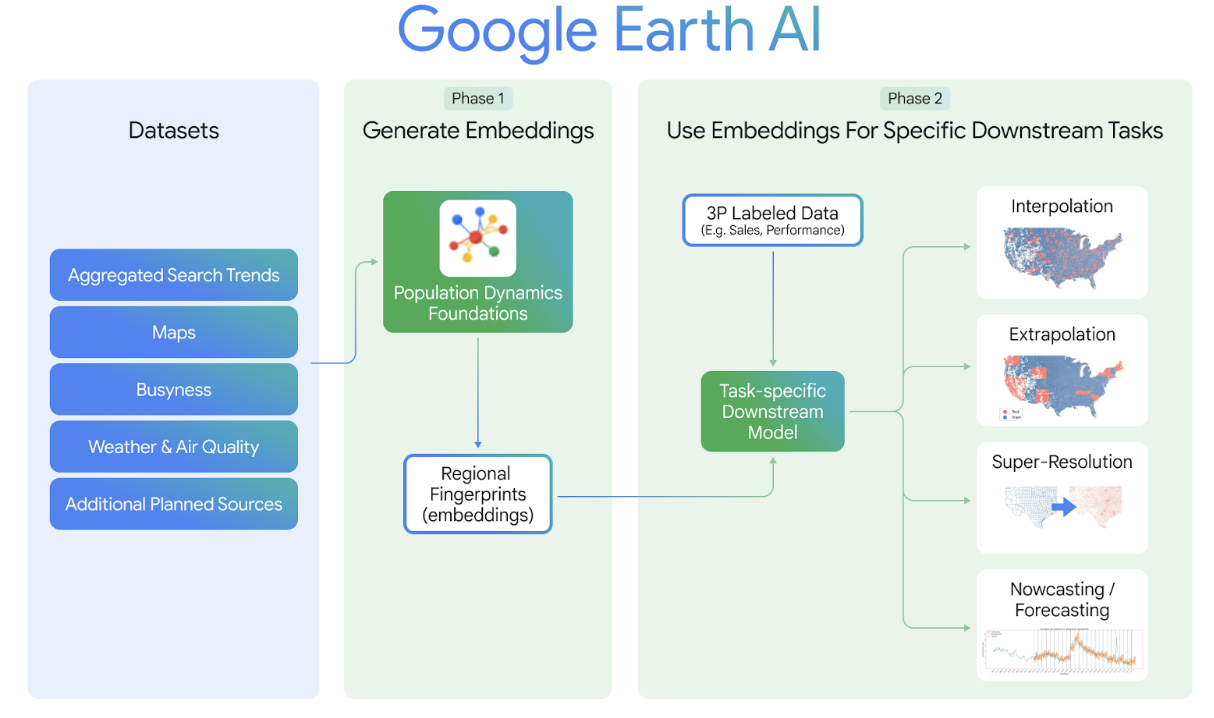
Google Earth AI can help public health officials understand the complex interactions of population behaviors and environmental factors, combining unique insights with region or context-specific health information.
AI as an accelerator of biomedical and scientific discovery
We also see incredible momentum in using AI across the scientific method, with promising early results for biomedical and life sciences research. Co-Scientist — a collaboration across Google Research, Cloud AI and Google DeepMind — along with Gemini Deep Think, are becoming valuable AI collaborators for hypothesis generation. Our research in AI-driven expert-level empirical software goes one step further, allowing us to reimagine the process of scientific computing as a series of parallel experiments run by an evolutionary coding agent. We’ve tested these systems on a wide range of multidisciplinary challenges, spanning the fields of single cell analysis, public health and neuroscience.
Building on our history of genomics innovation, we developed DeepSomatic, a genomic data analysis research tool designed to more accurately identify cancer-related genetic mutations. When tested on multiple cancer types, DeepSomatic identified key variants missed by prior state-of-the-art tools, offering the potential for our partners to improve cancer research, diagnosis and treatment.
A new era of healthcare
We are in the midst of a profound transformation. Our research in multimodal open-weight models and multi-agent systems has the potential to make healthcare more accurate and personalized, diseases more detectable and more treatable, and public health ecosystems more resilient.
As we advance our breakthrough research, we continue to adhere to the highest standards of scientific rigor, and to bring our research from the lab to clinical settings responsibly, working closely with patients, medical professionals, public officials, researchers and scientists. We believe if we build models and systems to be truth-seeking, based on evidence, transparency, and reproducibility, we should see both life-changing and life-saving results. We are excited to realize the full benefits of AI to help everyone, everywhere live longer, healthier lives.
Quick links
Other posts of interest
-

July 15, 2026
Towards demystifying the creativity of diffusion models- Algorithms & Theory ·
- Generative AI ·
- Machine Intelligence
-

July 9, 2026
SensorFM: Towards a general intelligence and interface for wearable health data- Generative AI ·
- Machine Intelligence
-

June 30, 2026
Introducing TabFM: A zero-shot foundation model for tabular data- Data Management ·
- Machine Intelligence ·
- Product
