SensorFM: Towards a general intelligence and interface for wearable health data
July 9, 2026
Xin Liu, Senior Research Scientist, and Daniel McDuff, Staff Research Scientist, Google Research
We present SensorFM, a foundation model for wearable health pre-trained on more than one trillion minutes of sensor data from five million people. By co-scaling model size and data, SensorFM learns a general-purpose representation of human physiology that transfers to 35 health prediction tasks, supports label-efficient adaptation and data infilling, and can serve as a grounding tool for a Personal Health Agent.
Quick links
Estimates suggest that billions of wearable devices are now in use, precisely tracking heart rate, movement, skin temperature, blood-oxygen levels, and sleep across days, weeks, and months. This continuous, longitudinal stream of physiology and behavior provides one of the most promising raw materials for preventive, personalized health. Yet turning those low-level signals into meaningful insights remains hard. First, baseline physiology, lifestyle, and health vary enormously from person to person, so a pattern that signals risk in one individual may not in another. Second, the labels needed to train models — confirmed diagnoses, lab results, validated questionnaires — are expensive, slow to collect, and essentially impossible to gather retrospectively. As a result, most wearable health models have been built one outcome at a time, with bespoke, supervised pipelines that target a narrow endpoint and struggle to generalize across the full breadth of human health.
In “Towards a General Intelligence and Interface for Wearable Health Data”, we take a different approach. We introduce SensorFM, a Large Sensor Foundation Model that learns directly from unlabeled wearable data at population scale. Pre-trained on over one trillion minutes of multimodal sensor signals drawn from five million consented participants, SensorFM learns a single, reusable representation of sensed human physiology — one that transfers across cardiovascular, metabolic, sleep, and mental health, as well as lifestyle and demographic factors. To our knowledge, this is the largest and most diverse wearable dataset used to train a model to date.
Learning from a trillion minutes of sensor data
To build the pre-training corpus, we sampled de-identified data from five million people who had consented to the use of their data for health and wellness research, captured between September 2024 and September 2025. The dataset spans more than 100 countries, all 50 U.S. states, and over 20 Fitbit and Pixel Watch device models. From each person we drew several weeks of data, yielding over two billion hours — more than a trillion minutes — of minute-resolution signals.
SensorFM ingests 34 one-minute aggregate features derived from five sensor modalities: photoplethysmography (PPG), accelerometry, electrodermal activity (EDA), skin temperature, and altimetry. Together these capture heart rate and heart-rate variability, blood-oxygen saturation, sleep stages, motion and steps, skin conductance, and temperature over a full 24-hour window.
Rather than relying on labels, SensorFM learns through self-supervised reconstruction, building on the LSM-2 approach and its Adaptive and Inherited Masking (AIM) framework. This is a crucial design choice, because missing and fragmented data (e.g., stretches of time where data is not available) is the norm with wearable devices, caused by a variety of factors such as sensors’ power-cycle, devices coming off the wrist, power saving modes of operation, and sensors switching on and off. Conventional self-supervised methods assume complete, uninterrupted inputs and so are forced to either impute the gaps (which can introduce bias) or discard incomplete windows (which throws away valuable data). AIM takes neither path: it treats real-world missingness as a natural artifact and learns directly from incomplete recordings, combining the tokens inherited from genuine gaps with those artificially masked for the reconstruction objective and treating the two as equivalent. The result is a representation that is missingness-aware by construction. SensorFM does not just tolerate fragmented data, it uses it productively, as the generative results below show.

SensorFM is pre-trained on over a trillion minutes of multimodal sensor data via missing-aware masked reconstruction.
Scaling model and data together pays off
A central question for any foundation model is whether scale translates into capability. We ran a systematic set of scaling experiments, spanning four orders of magnitude in both pre-training data volume (from roughly 2 million to 2 billion sensor-hours) and model size (from 100K to 100M parameters).
The result is a clean, encouraging signal: pre-training loss falls predictably as data and capacity grow, and — crucially — those gains carry over to downstream health tasks. The largest model (SensorFM-B) trained on the full five-million-person corpus reduces reconstruction loss by 31% over the smallest variant, and improves downstream performance by an average 9% performance gain (AUC) on classification tasks and 21% of performance gain (Pearson Coefficient) on regression tasks.
The biggest improvements come from scaling both dimensions at once. Increasing data and capacity in proportion produces near-linear gains in both generative pre-training and discriminative downstream performance — and the curve shows no sign of saturating. Across model variants, SensorFM-B wins on 33 of 35 tasks.

Co-scaling data and model capacity by orders of magnitude yields gains in both pre-training and downstream performance, with no sign of saturation.
One representation, many health domains
To test how general the learned representation really is, we evaluated SensorFM across 35 discriminative health tasks drawn from three independent, Institutional Review Board Approved prospective studies with a total of 13,985 participants. The tasks span six categories: cardiovascular health, metabolic risk, mental health, sleep, demographics, and lifestyle.
To probe the quality of the embeddings directly, we kept the SensorFM encoder frozen and trained only a lightweight linear head on top of it — then compared against supervised baselines trained on engineered features. Here’s what we found:
- Broad generalization: Linear probes on SensorFM embeddings outperform the feature-engineered supervised baseline on 34 of 35 tasks, without any task-specific architecture.
- Physiology learned implicitly: Adding demographic features (age, sex, etc.) gives a modest boost — but that boost shrinks as the model scales, suggesting larger models implicitly capture physiologically relevant traits during pre-training.
- Strength in hard-to-measure conditions: Scaled pre-training is especially valuable for conditions like depression and anxiety, which vary from person to person and leave only faint traces in sensor data. SensorFM appears to learn the individual differences that usually bury such signals and pick out the patterns that carry across people.
- Label efficiency: With only a small fraction of labeled examples, SensorFM quickly surpasses both demographic-only and feature-engineered baselines — an important property in healthcare, where high-quality labels are scarce.
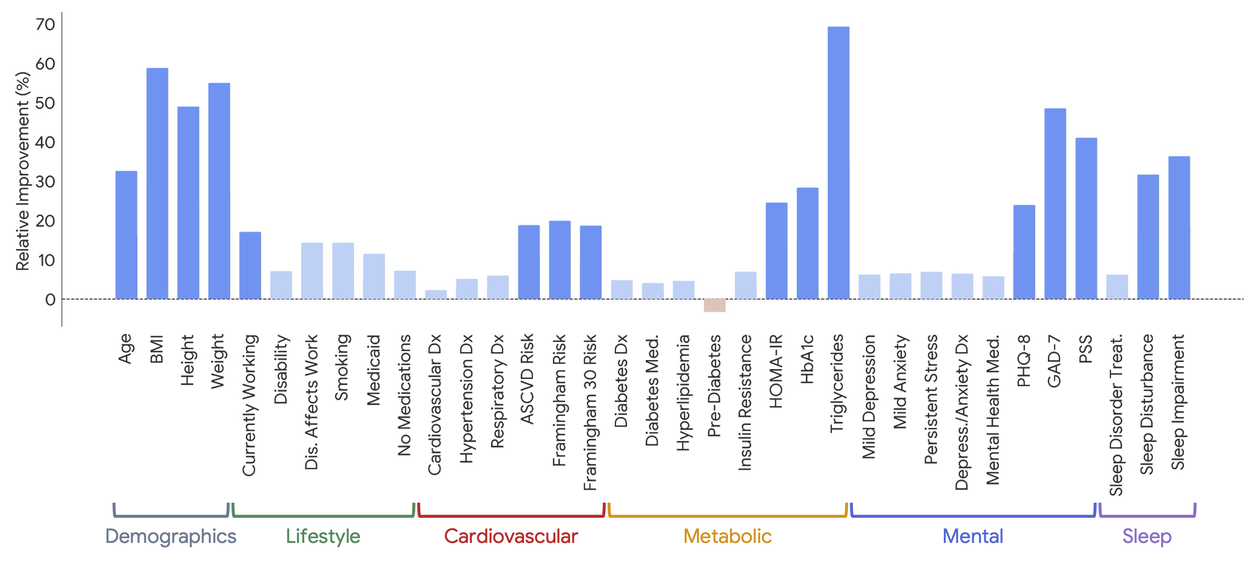
Relative performance improvement of linear probing on frozen SensorFM embeddings across discriminative health tasks.
A “classroom” of agents to build prediction heads
A general embedding is only as useful as the effort required to adapt it. Traditionally, turning embeddings into a strong predictor for each new endpoint demands manual feature engineering, architecture selection, and hyperparameter tuning — tedious work that gets harder as the number of tasks grows.
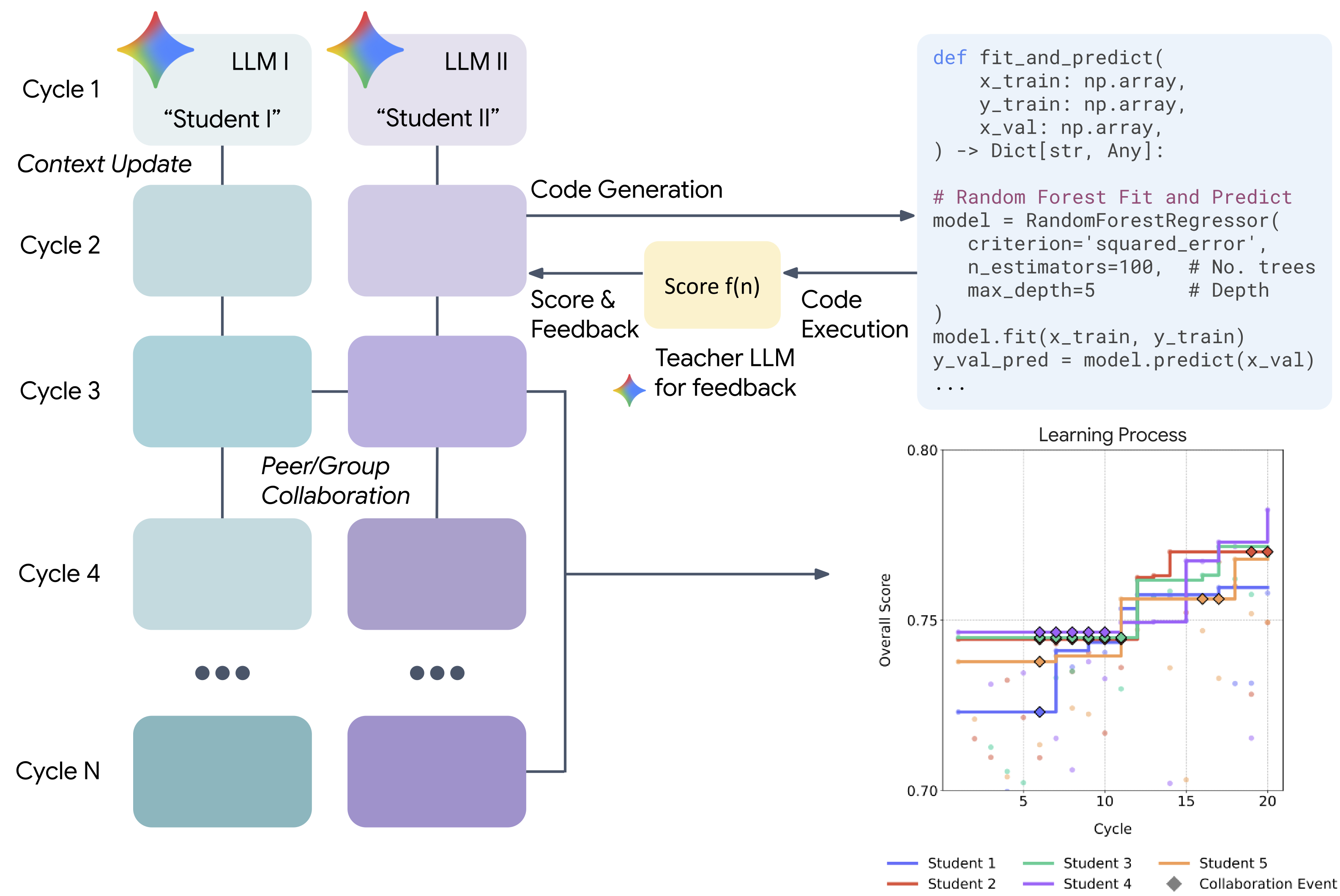
To automate this, we built an agentic “classroom”: a set of collaborating and competing LLM agents that iteratively generate, test, and refine executable code to build prediction heads on the SensorFM embeddings. Across our experiments the system explored more than 30,000 candidate solutions.
The agent-designed heads beat a simple linear probe on 16 of 20 classification tasks and 12 of 15 regression tasks. Two patterns stood out: solution quality improves monotonically over the search, and it scales with the capability of the underlying LLM — more capable models (such as more recent versions of Gemini) produce better solutions, while collaboration between agents helps less capable models close the gap.
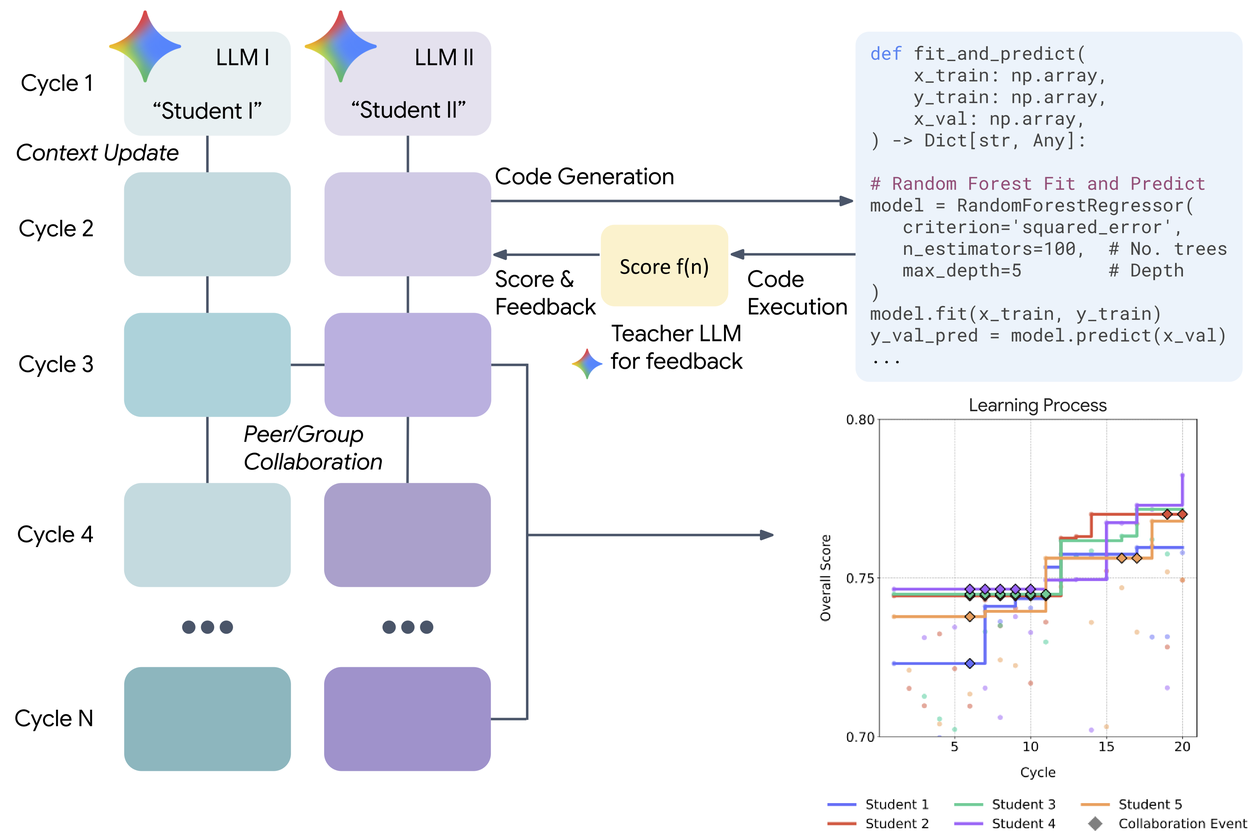
A “classroom” of LLM agents iteratively writes, tests, and refines code to build prediction heads on SensorFM embeddings, improving solutions over time.
Grounding a Personal Health Agent
Finally, we asked whether SensorFM is useful end-to-end — as a tool that grounds an AI health coach in a person’s own physiology. We integrated SensorFM into a Personal Health Agent and compared three conditions for generating health summaries from 31 real participant profiles:
- Demographics + daily wearable metrics + SensorFM predictions
- Demographics + daily wearable metrics + ground-truth measurements
- Demographics + daily wearable metrics only (baseline)
A panel of clinicians, blinded to condition, rated the resulting summaries across five rubric dimensions — context, relevance, justifiability, personalization, and potential for harm — producing 1,860 ratings over more than 40 hours of expert evaluation. The findings are striking. Adding SensorFM predictions significantly improved responses over the baseline on every rubric dimension. And there was no statistically significant difference between grounding the agent in SensorFM predictions versus actual ground-truth measurements — meaning the model’s inferences served the agent about as well as the real labels would have.
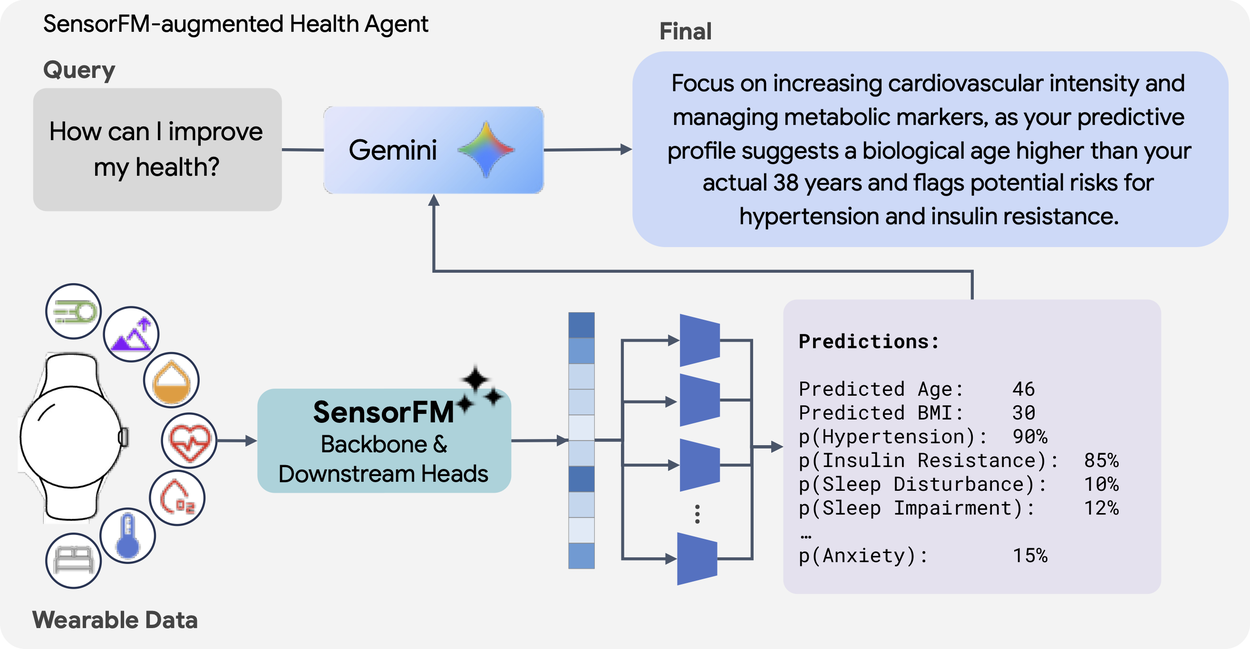
Using SensorFM as a tool for a Personal Health Agent improves clinician-rated responses.
Conclusion
SensorFM points toward a shift in wearable health research: away from many bespoke, single-outcome models and toward a single, generalist representation of human physiology that can be adapted flexibly, efficiently, and at scale. By learning from over a trillion minutes of unlabeled sensor data, it generalizes across cardiovascular, metabolic, sleep, and mental health; supports label-efficient adaptation and robust daily-metric estimation; can be specialized automatically by an agentic classroom; and can ground a Personal Health Agent in a person’s own signals.
Acknowledgements
We would like to thank our co-authors and collaborators from Google Research, Google DeepMind, and academia for their contributions to this work.
Quick links
Other posts of interest
-

October 14, 2026
Research@ 2026: 10 ways we're amplifying human ingenuity- General Science ·
- Generative AI ·
- Health & Bioscience
-

October 14, 2026
Analyzing technical documents with Deep Review- General Science ·
- Machine Intelligence ·
- Natural Language Processing
-
October 14, 2026
Putting Earth AI to work: Geospatial agents for our planet's biggest challenges- Earth AI ·
- General Science ·
- Machine Intelligence