Evaluation of Speech for the Google Assistant
December 21, 2017
Posted by Enrique Alfonseca, Staff Research Scientist, Google Assistant
Quick links
Voice interactions with technology are becoming a key part of our lives — from asking your phone for traffic conditions to work to using a smart device at home to turn on the lights or play music. The Google Assistant is designed to provide help and information across a variety of platforms, and is built to bring together a number of products — including Google Maps, Search, Google Photos, third party services, and more. For some of these products, we have released specific evaluation guidelines, like Search Quality Rating Guidelines. However, the Google Assistant needs its own guidelines in place, as many of its interactions utilize what is called “eyes-free technology,” when there is no screen as part of the experience.
In the past we have received requests to see our evaluation guidelines from academics who are researching improvements in voice interactions, question answering and voice-guided exploration. To facilitate their evaluations, we are publishing some of the first Google Assistant guidelines. It is our hope that making these guidelines public will help the research community build and evaluate their own systems.
Creating the Guidelines
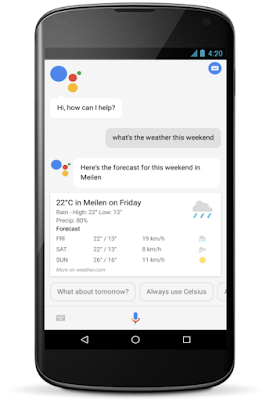
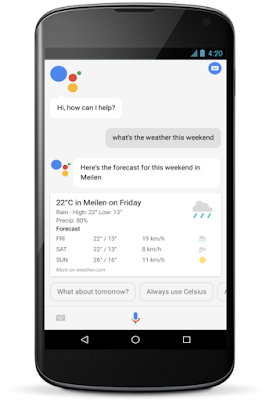
For many queries, responses are presented on the display (like a phone) with a graph, a table, or an interactive element, like you’d see for [weather this weekend].

But spoken responses are very different from display results, as what’s on screen needs to be translated into useful speech. Furthermore, the contents of the voice response are sometimes sourced from the web, and in those cases it’s important to provide the user with a link to the original source. While users looking at their mobile device can click through to read the original web page, an eyes free solution presents unique challenges. In order to generate the optimal audio response, we use a combination of explicit linguistic knowledge and deep learning solutions that allow us to keep answers grammatical, fluent and concise.
How do we ensure that we consistently meet user expectations on quality, across all answer types and languages? One of the tools we use to measure that are human evaluations. In these, we ask raters to make sure that answers are satisfactory across several dimensions:
- Information Satisfaction: the content of the answer should meet the information needs of the user.
- Length: when a displayed answer is too long, users can quickly scan it visually and locate the relevant information. For voice answers, that is not possible. It is much more important to ensure that we provide a helpful amount of information, hopefully not too much or too little. Some of our previous work is currently in use for identifying the most relevant fragments of answers.
- Formulation: it is much easier to understand a badly formulated written answer than an ungrammatical spoken answer, so more care has to be placed in ensuring grammatical correctness.
- Elocution: spoken answers must have proper pronunciation and prosody. Improvements in text-to-speech generation, such as WaveNet and Tacotron 2, are quickly reducing the gap with human performance.
The current version of the guidelines can be found here. Of course, guidelines are often updated, and these are just a snapshot of something that is a living, changing, always-work-in-progress evaluation!
Quick links
Other posts of interest
-

August 31, 2026
TimesFM-3: A zero-shot foundation model for multivariate forecasting- Data Management ·
- Machine Intelligence ·
- Product
-

June 30, 2026
Introducing TabFM: A zero-shot foundation model for tabular data- Data Management ·
- Machine Intelligence ·
- Product
-

June 5, 2026
Unlocking dependable responses with Gemini Enterprise Agent Platform’s Agentic RAG- Data Management ·
- Machine Intelligence ·
- Natural Language Processing ·
- Product