Empirical Research Assistance (ERA): From Nature publication to catalyzing Computational Discovery
May 19, 2026
Lizzie Dorfman, Product Manager, and Michael Brenner, Research Scientist, Google Research
Published today, Empirical Research Assistance (ERA) is an AI tool for expert-level scientific coding that helped build the Computational Discovery prototype, now available through a trusted tester program in Google Labs.
One of AI’s greatest potential benefits to humanity is increasing the speed and scope of scientific discovery. Empirical Research Assistance (ERA), a Google-developed research tool that uses Gemini to write and optimize scientific code, addresses one of the most time-consuming parts of scientific research: iteratively testing and refining computational experiments. It is described in "AI system designed to help scientists write expert-level empirical software”, published today in the journal Nature.
As part of our wider science announcements at I/O today, we are also making this technology accessible as a tool that can begin to help scientists around the world. ERA is one of the systems used to build Computational Discovery, a new experimental tool that is starting to roll out more broadly today through Gemini for Science.
Introducing ERA as a versatile tool for scientific coding
We first shared the design and performance of ERA in the fall, when the preprint was released. Given a scientific problem and a measure of success, ERA can search scientific literature, write code, explore solutions, combine techniques and evaluate the results. ERA considers thousands of options, using a tree search approach to optimize its output code against its given goal.
Our Nature publication describes testing ERA on benchmark problems spanning a variety of disciplines: genomics, public health, satellite imagery analysis, neuroscience prediction, a general time-series forecasting benchmark, and mathematics. Results show ERA achieves expert-level performance across all of these benchmarks, potentially democratizing future access to expert-level computational modeling and expanding the capabilities of current experts.
Applying ERA to open scientific questions
Over the past six months, Google Research scientists and our collaborators have been actively experimenting with ERA. In late April, we shared examples of four projects we’d worked on that use ERA to investigate current open problems in science.
We now have a total of eight manuscripts that apply ERA to specific scientific problems, including the five newly released papers described below. Collectively, these results show how ERA can help drive progress in several domains with immediate scientific impact and public benefit.
- Google scientists and collaborators published an analysis of their work using ERA for epidemiological forecasting, predicting U.S. hospital admissions at a state level up to four weeks in advance for flu, COVID-19 and RSV. ERA forecasts consistently rank at or near the top of public Centers for Disease Control (CDC) leaderboards for all three respiratory viruses, and employ techniques that can easily be replicated for other countries and diseases.

Left: Google’s forecasted weekly hospital admissions across California for flu, COVID-19, and RSV, starting when each forecast began through the end of May. The black line shows observed hospital admissions. Right: The ranking of different models shows that Google’s forecasts (blue) performed the best for season-averaged accuracy in all three respiratory viruses. CDC’s ensemble forecasts (striped bars) are given a relative Weighted Interval Score of 1. Other research groups’ forecasts are solid red bars (only the best-performing models are shown).
- We used ERA to create a forecasting model of seasonal runoff across California's snow‑fed river basins — a vital resource for the state's population and agricultural sector. The resulting model produces significantly more accurate early predictions of spring runoff than Bulletin 120 (B120), the state's official seasonal water supply outlook, potentially improving management of this scarce resource.
- We shared new results that use ERA to map atmospheric carbon dioxide (CO2) concentration with unprecedented spatial and temporal resolution using data from a geostationary weather satellite. The ERA-developed model captures changes in CO2 concentration resulting from human activity, including distinct urban enhancements. The model-derived estimates also show how crops and other plants absorb CO2 as they grow, causing CO2 concentration to dip during the day, and how other natural and human cycles play out in the atmosphere. These AI estimates will help to model, monitor and understand how CO2, a critical greenhouse gas, varies over space and time.
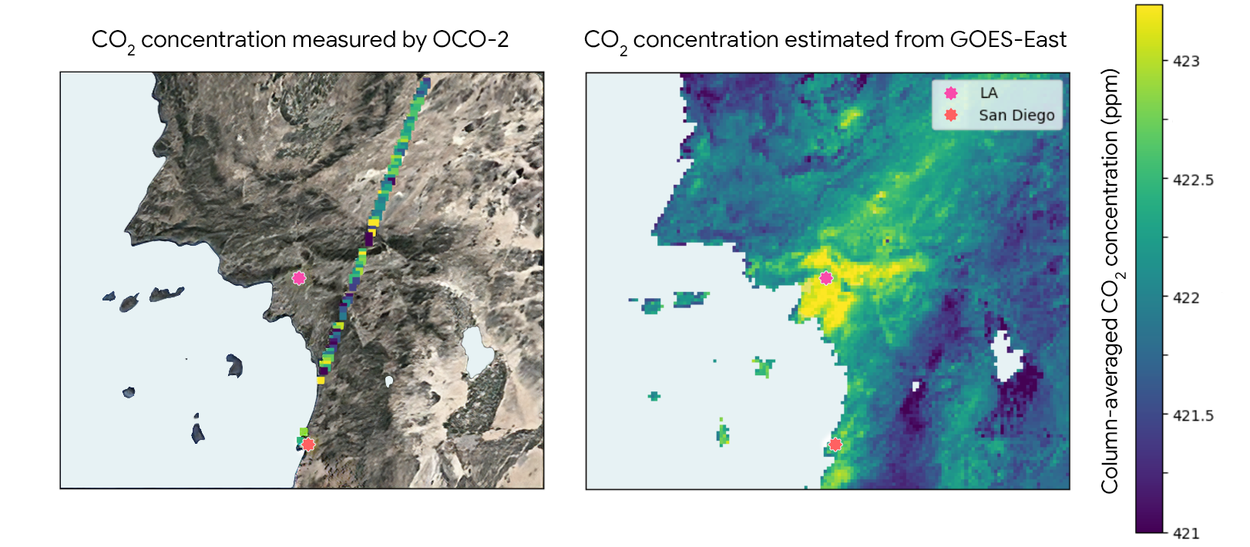
Atmospheric CO2 concentration over southern California on Oct. 18, 2024. The Orbiting Carbon Observatory-2 satellite takes detailed measurements along a single path (left), returning to each location every 16 days. ERA takes GOES-East weather satellite data and combines it with other information (right) to estimate CO2 concentration every 10 minutes, everywhere. These estimates clearly show the pattern of urban emissions from the Los Angeles basin. Such detailed maps can help to model, monitor and predict how this critical greenhouse gas varies over space and time.
- We explored 3D solar energy maximization using ERA and Google Antigravity to optimize the solar energy capture of different panel topographies, as a case study in how to combine these two systems. ERA found that a 500-triangle volumetric fan was able to trap scattered solar radiation with zero backward shading, maximizing the energy capture in a potential design for a future solar energy device.
- We also applied ERA to the task of retail forecasting — the branch of economics that ensures customers access what they need, businesses can operate efficiently, waste is minimized, and governments can optimize economic policy. Using widely available inputs such as U.S. economic indicators, Google Trends data, historical patterns and consumer sentiment, the ERA-devised model was able to meet or exceed both a commercially available consensus estimate and the Chicago Fed Advance Retail Trade Summary (CARTS) monthly retail forecast.
Introducing Computational Discovery, built with ERA and AlphaEvolve
Today, Google will begin gradually opening access to Computational Discovery, built with AlphaEvolve and ERA. We are excited for this new era of scientific discovery enabled by AI-based computational tools, and to further develop them alongside the broader community.
Another of the newly launched Gemini for Science experiments is Hypothesis Generation, built with AI Co-Scientist, also described in a paper published today in Nature. Hypothesis Generation and Computational Discovery, as well as the new Literature Insights experimental tool, are complementary in their support of different stages of the scientific method. Visit labs.google/science to register your interest.
Acknowledgements
We’d like to thank our collaborators, listed on the authors’ list, who helped create ERA, as well as all the scientists who are among the early adopters. Algorithm development underlying ERA was led by Eser Aygun, Gheorghe Comanici and Shibl Mourad. The epidemiological forecasting work is led by Zahra Shamsi, Sarah Martinson, Nicholas Reich, Martyna Plomecka, and Brian Williams. The research on carbon dioxide monitoring is led by Aarón Sonabend-W, Sean Campbell, Renee Johnston, Vishal Batchu, Carl Elkin, Christopher Van Arsdale, John Platt, and Anna Michalak. The paper on runoff forecasting is authored by Ignacio Lopez-Gomez, Michael Brenner, and Tapio Schneider. The manuscript in solar energy engineering is authored by Michael Brenner, Lizzie Dorfman, and John Platt. The research in macroeconomic retail sales forecasting is led by Michael Brenner, Qian-Ze Zhu, Zahra Shamsi, Mette Nielsen, and Paul Raccuglia. We are grateful for leadership support from John Platt, Michael Brenner, Shibl Mourad, Lizzie Dorfman, Vip Gupta, Zoubin Ghahramani, Alison Lentz, Erica Brand, Katherine Chou, Ronit Levavi Morad, Yossi Matias, and James Manyika.
Other posts of interest
-

October 5, 2026
Open and Emergent Problems in Agentic Privacy and Security: A Contextual Angle- Generative AI ·
- Natural Language Processing ·
- Security, Privacy and Abuse Prevention
-
September 29, 2026
How Diffusion Controller unifies and simplifies AI image generation- Algorithms & Theory ·
- Machine Intelligence
-

September 24, 2026
Automating coherent long-form video generation- Generative AI ·
- Machine Intelligence

