The power of collaboration: How we can reduce traffic congestion
July 7, 2026
Neha Arora and Aboudy Kreidieh, Software Engineers, Google Research
We demonstrate the effect of network-aware routing in navigation apps on improving network efficiency.
Quick links
Vehicle transportation underpins much of modern life, enabling the movement of goods and people, productivity, and economic growth. However, the costs are high: drivers spend an average of 2.6 years of their life on the road, and private cars and vans now account for around 10% of global CO2 emissions. Hence, the efficient use of transportation networks is of paramount importance. Can road traffic routing be managed system-wide the way aviation manages airspace or the internet routes data packets? While ground transportation has historically lacked a physical control tower, digital platforms offer a powerful glimpse into a more coordinated future.
The proliferation of navigation services, connected vehicles, smart cities, and autonomous vehicles all provide opportunities to improve both measurement and optimization of transportation resources. Google Research has already demonstrated the power of infrastructure-level intervention with Project Green Light, which uses AI to optimize city traffic lights. Unfortunately, optimizing vehicle networks has proven challenging. While individual vehicle routing is standard across all the top navigation products, optimizing routing system-wide is not yet present. Although theoretical models for network optimization exist, large-scale empirical validation remains limited, thereby hindering forward progress.
In “Urban congestion relief experiments through routing-app interventions”, published in Nature Cities, we present the first large-scale, real-world study into the use of navigation platforms to improve traffic. We show that coordinating even a small fraction of trips to disperse traffic can measurably improve driving speeds and reduce emissions for the entire city. It also establishes an experimentation framework for evolving from individual trip optimization toward a cooperative routing paradigm that enhances total network efficiency.
Experiment
We ran an experiment in 10 major US cities to demonstrate the effectiveness of targeted low-cost routing interventions in improving overall traffic conditions. For this study, the Google Maps algorithm was modified to prefer alternative routes with similar travel times and segment types, effectively guiding trips away from the pre-selected congested segments.
Over a six month period, we adopted a city-wide switchback (also known as crossover) experimental design, alternating between this treatment and the control (unaltered) routing algorithm over consecutive days to appropriately measure the effect of this intervention. Rather than randomly selecting individual trips, the intervention was applied systematically across the entire city. During “treatment” days, the modified routing guided all trips that encountered the pre-selected congested segments toward alternative routes with similar travel times. Under 2% of observed trips received altered routing recommendations as a result of this experiment.
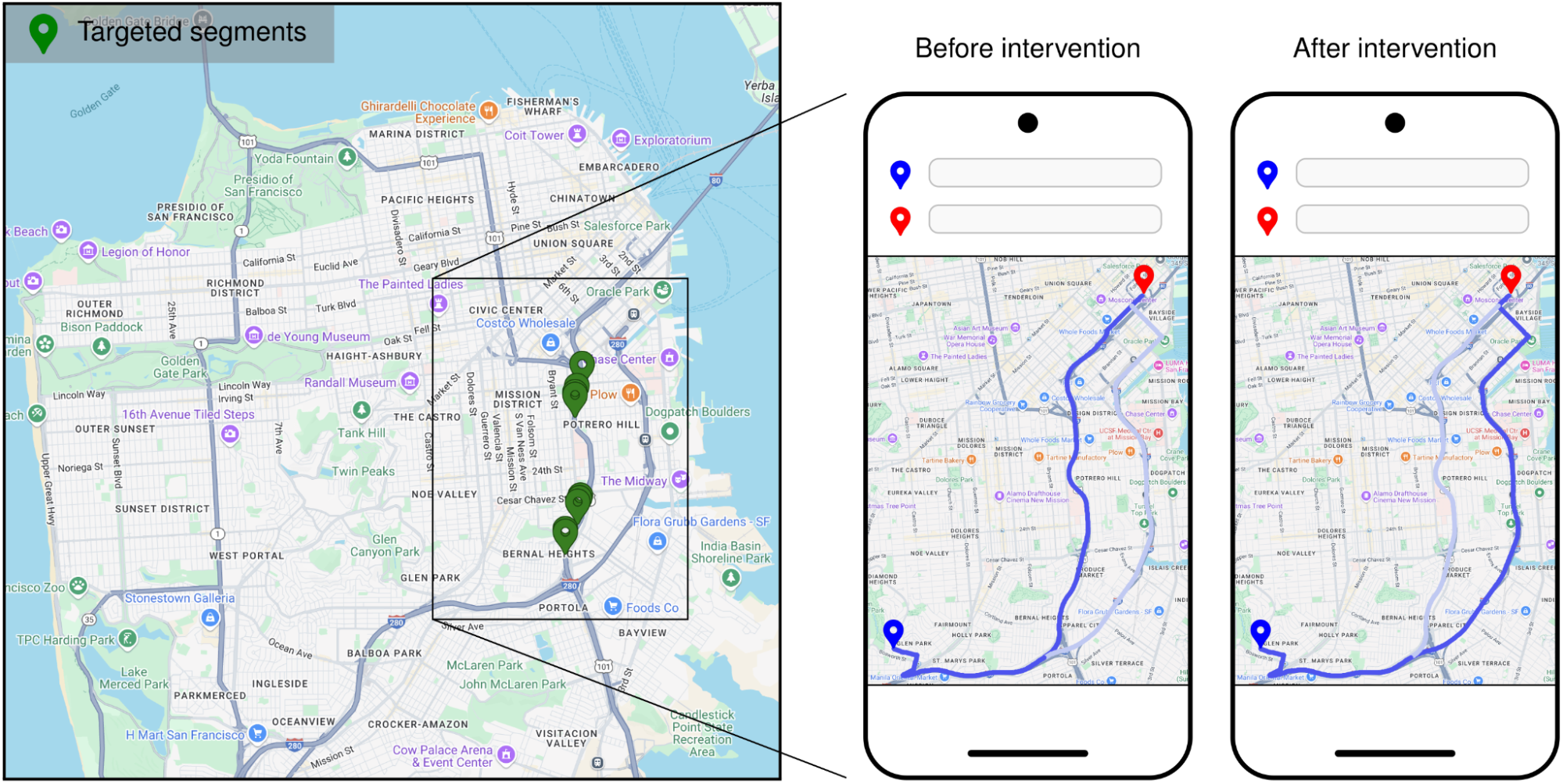
To set up the experiment, cities were chosen based on the congestion levels and ground truth availability. For each city, we selected roughly 100 road segments based on historical congestion patterns, characterized by recurring bottlenecks or high traffic density during peak demand. The figure below shows one such example.
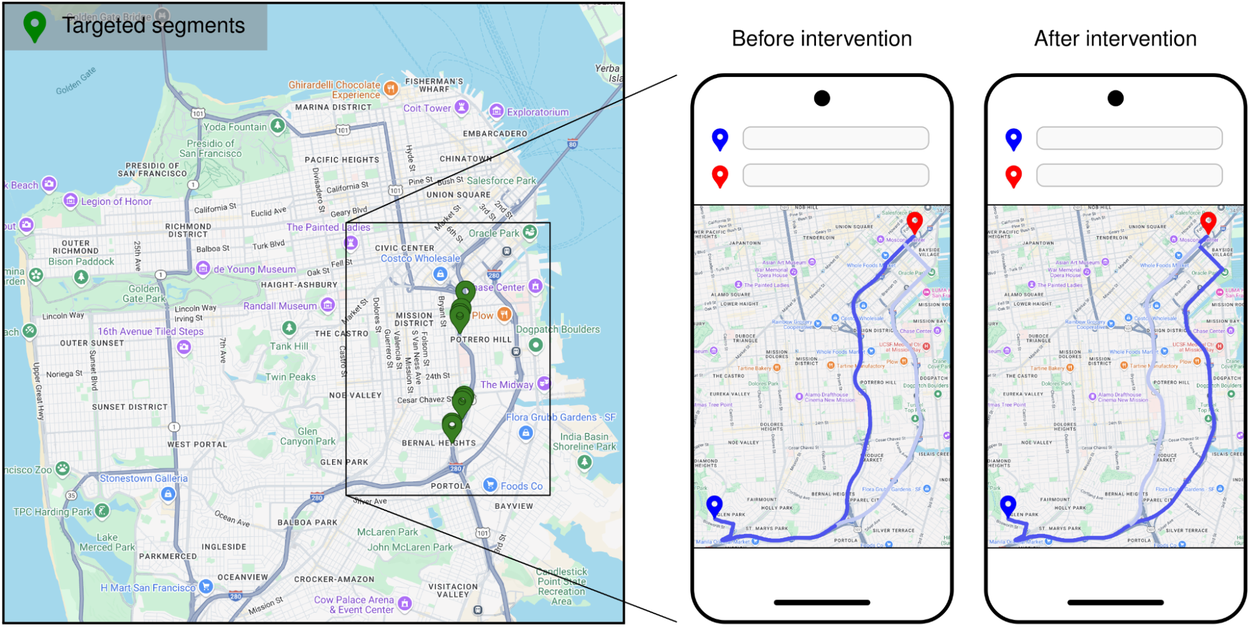
Within this study, we modify at the routing stage the perceived cost to trips passing through pre-selected segments depicting disproportionately high levels of demand and/or congestion. These modifications reroute trips with similarly costing alternative paths away from these segments, thereby reducing the flow of traffic that would have otherwise been experienced within them.
Results
To quantify the effect of our proposed routing intervention, we employed a hierarchical Bayesian outcome modeling framework for our analysis. This approach, which models parameters at both the aggregate city level and localized hourly level simultaneously, offers a flexible way to capture shared variations without imposing strict constraints. It also enables information sharing between cities and time periods, allowing estimates for a particular city or time to borrow strength from other subgroups' effect estimates.
The study found that even these small interventions led to measurable, statistically significant improvements in traffic conditions. Averaged across cities, we observe a median increase of around 2% in driving speeds on targeted segments, corresponding to a median decrease of 0.5% to 1.0% in fuel consumption rates. Over the much larger set of affected segments, i.e., all segments that were impacted by the intervention, including those to which traffic was redirected either away from or onto, driving speeds increased by around 0.35% on median, and 0.5% when traffic is highest in the morning and afternoon. At the scale and energy demands of the cities considered in this study, this translates to potential savings of thousands of tons of CO2e emissions per city per year.
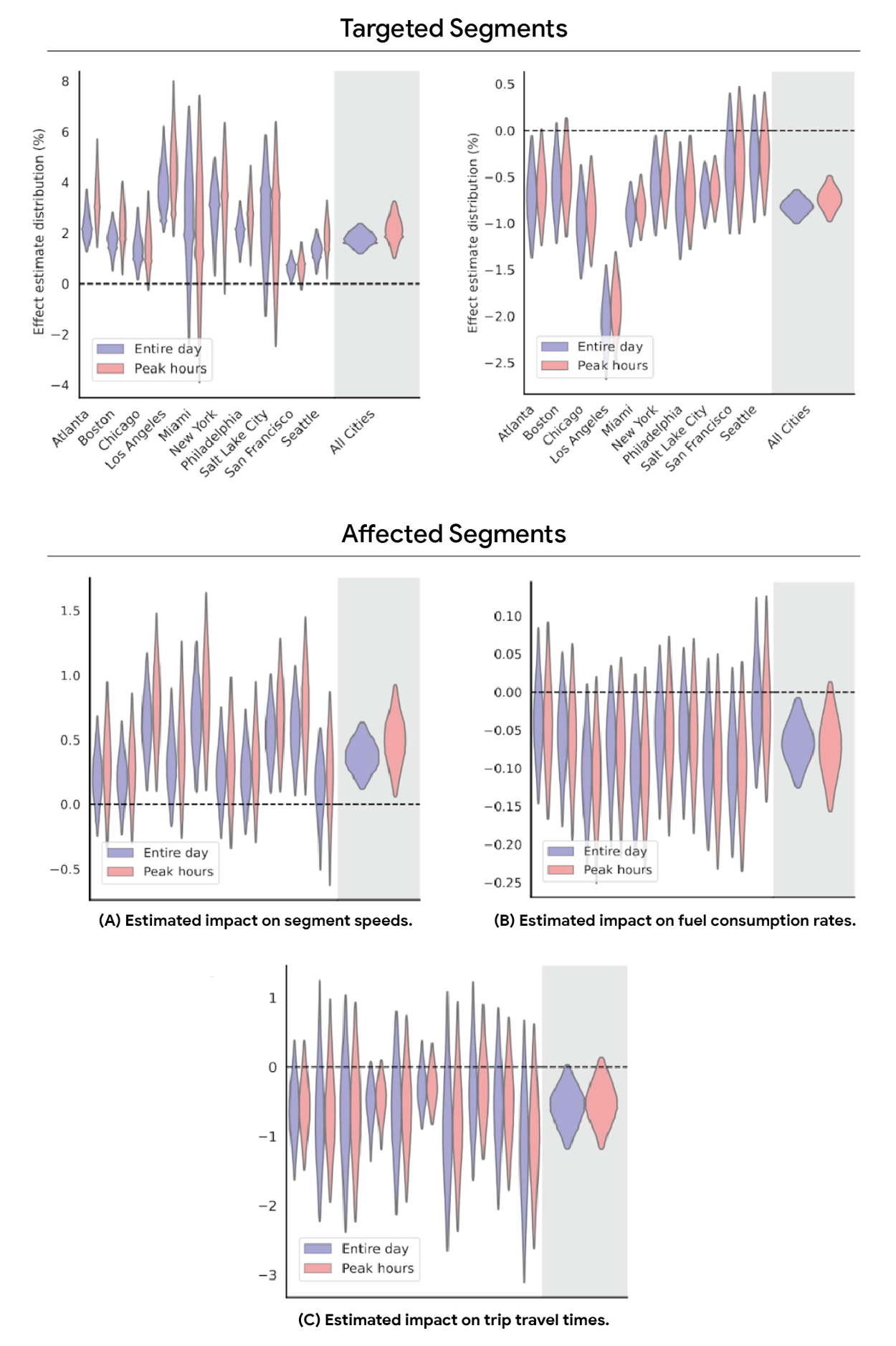
Estimated outcomes on trip travel times, speeds, and estimated emissions. Each plot quantifies the posterior probability distribution of outcomes from the intervention, and is represented in terms of percentage changes in speeds or emission rates. We see notable improvements to both targeted and affected segment speeds and fuel consumption rates. Outcomes when computed across all affected segments are understandably more diffuse but still positive, particularly during peak hours.
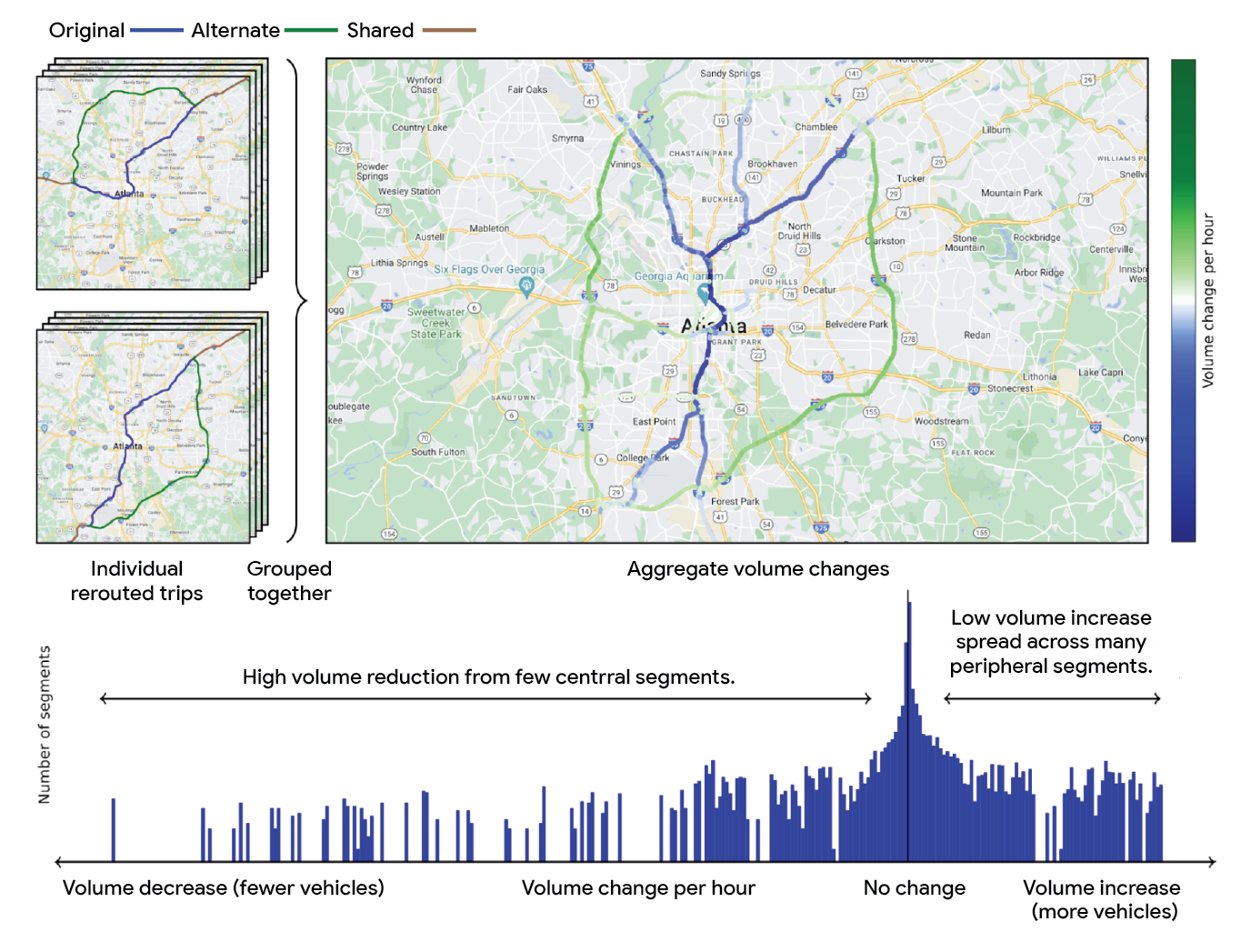
Improvements in driving speeds and emission rates were both prevalent and statistically significant across the network. These gains were the result of the strategic diversion of vehicles from major bottlenecks; by dispersing this traffic efficiently, the peripheral roads maintained higher average speeds and lower overall emissions, even when absorbing higher volumes of vehicles. This behavior is illustrated in the figure below.
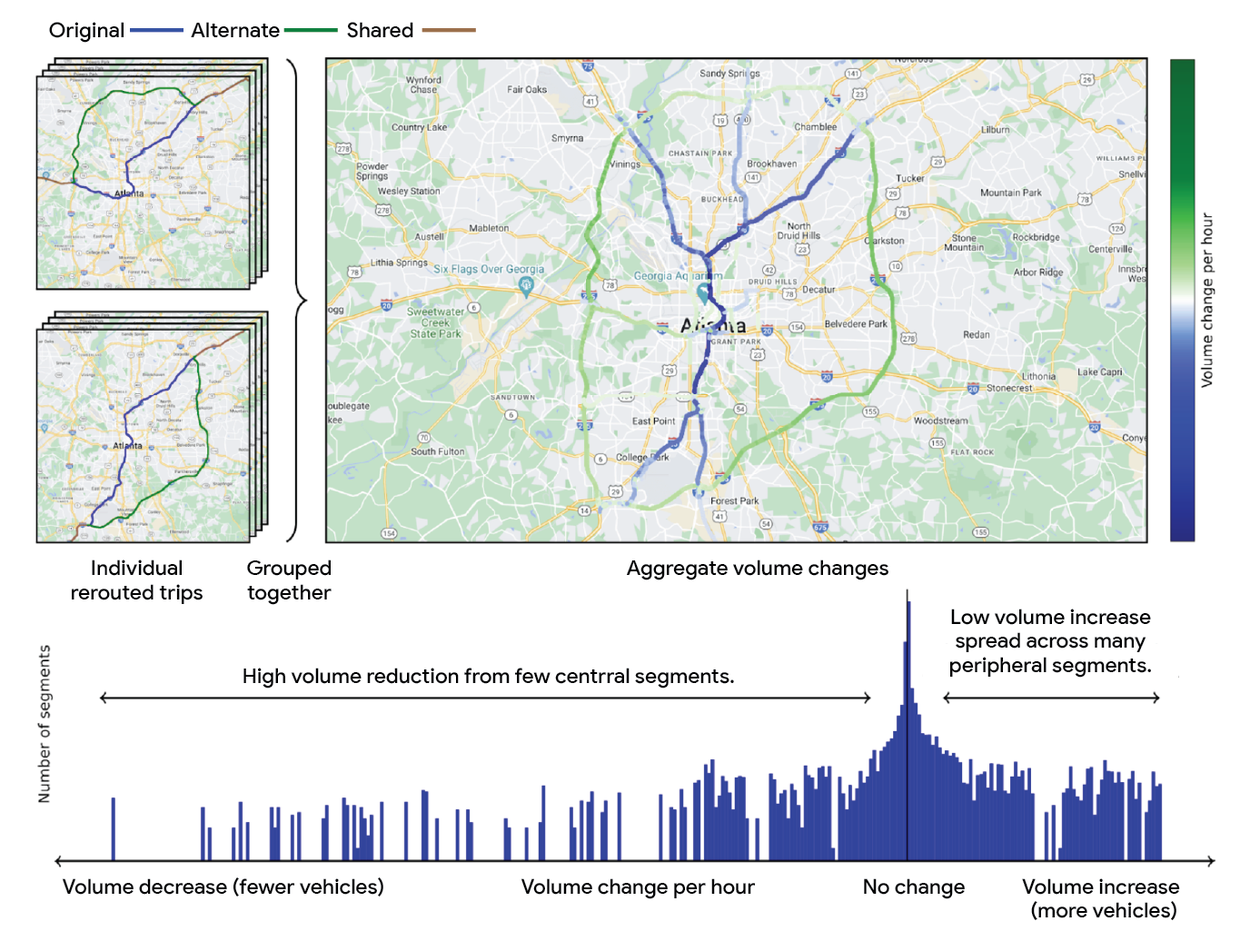
A demonstration of the dispersion of traffic in Atlanta induced by the treatment. Top: Routes on aggregate were diverted away from (blue) the central highway passing through the city and onto (green) a spatially more distributed set of segments primarily spanning the periphery of the region. Bottom: Histogram of net volume changes on individual segments. Indeed, vehicles were dispersed from concentrating on a smaller number of high volume segments to a larger number of segments that each received lower volume increases, resulting in a net benefit to the system.
Conclusion
This research clearly shows that networked navigation technology can be a powerful tool for proactively shaping traffic flow for the benefit of society. By coordinating a small fraction of trips, we can achieve systemic gains that benefit all road users — not just those using a specific app. Notably, both navigation users and non-users share the advantages of decongesting targeted segments, leading to network-wide improvements in travel time and a reduction in CO2e emissions.
Beyond immediate congestion relief, this work establishes a blueprint for a rigorous, experiment-based approach to traffic management. As smart-city infrastructure matures, the experimental pathway demonstrated here — using connectivity to measure and facilitate system-level changes — can be applied to broader challenges like dynamic signal control and real-time network optimization in complex urban environments. While these results show the potential of relatively simple rerouting, they provide the foundation for a future where cars, infrastructure, and network-aware routing work together to optimize travel efficiency and sustainability for the entire community.
Acknowledgements
This work was conducted in collaboration with Alexandre Bayen, Andrew Tomkins, Theophile Cabannes, Kevin Chen, Yechen Li, Marc Nunkesser, Prem Ramaswami, Eray Turkel, Shoshana Vasserman, and Haizheng Zhang.
Quick links
Other posts of interest
-

September 29, 2026
How Diffusion Controller unifies and simplifies AI image generation- Algorithms & Theory ·
- Machine Intelligence
-

September 18, 2026
MilleMiglia: A realistic instance generator for middle-mile logistics- Algorithms & Theory
-
September 15, 2026
Bypassing inference bottlenecks: Accelerating complex AI search with Retrieve-for-Train- Algorithms & Theory ·
- Data Mining & Modeling ·
- Generative AI